
A Noteworthy Gallery

The above pages documented clinical lectures delivered and operations performed by the “Medical & Surgical Staff of the New York Hospital” between 1878 and 1879.
By The Editors and Archives & Special Collections staff | Photos by Jörg Meyer
From detailed accounts of infectious disease lectures to irreverent doodles of faculty members, student notebooks provide a candid glimpse into centuries of classroom life, as well as a unique record of the evolving field of medicine.
Dating from 1774 to 1964, some 175 notebooks recorded by Columbia’s medical, dental, nursing, and pharmacy students are preserved by Archives & Special Collections at the Augustus C. Long Health Sciences Library. The collection includes treasures such as notes on emerging medical theories, illustrations of case studies, and the renowned names of medical trailblazers.
The Archives team opened its notebook collection to Columbia Medicine, revealing some of the most cherished pages recorded by past College of Physicians and Surgeons students.

Lectures From Founding Faculty
This elaborate title page is the work of student Charles Drake (P&S’1812), who would later serve the College as a trustee from 1820 to 1832. He was recording the lectures of Dr. John Augustine Smith, who was one of the original faculty members at the opening of the College of Physicians and Surgeons in 1807 and would serve as president of P&S from 1831 to 1843.
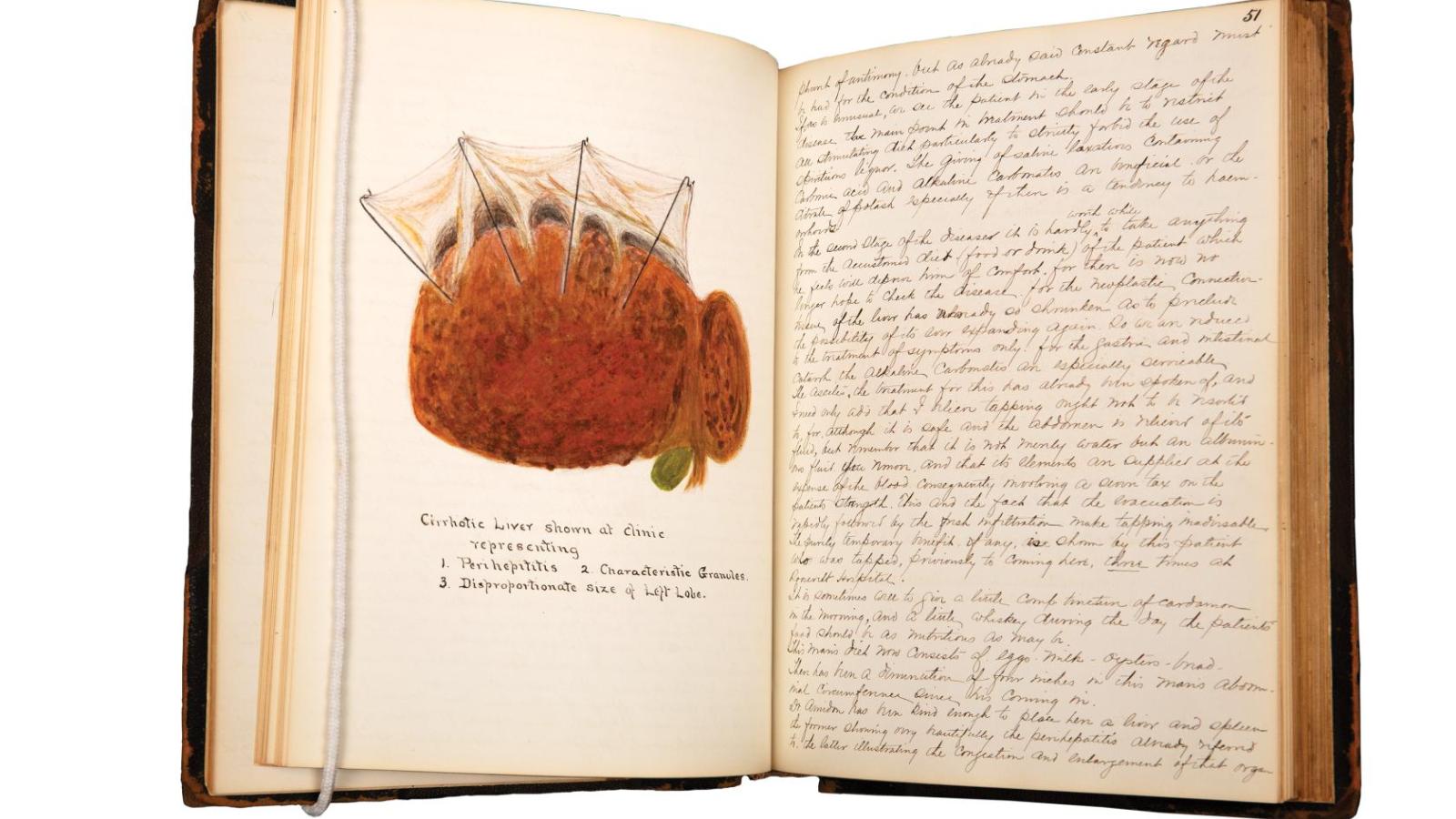
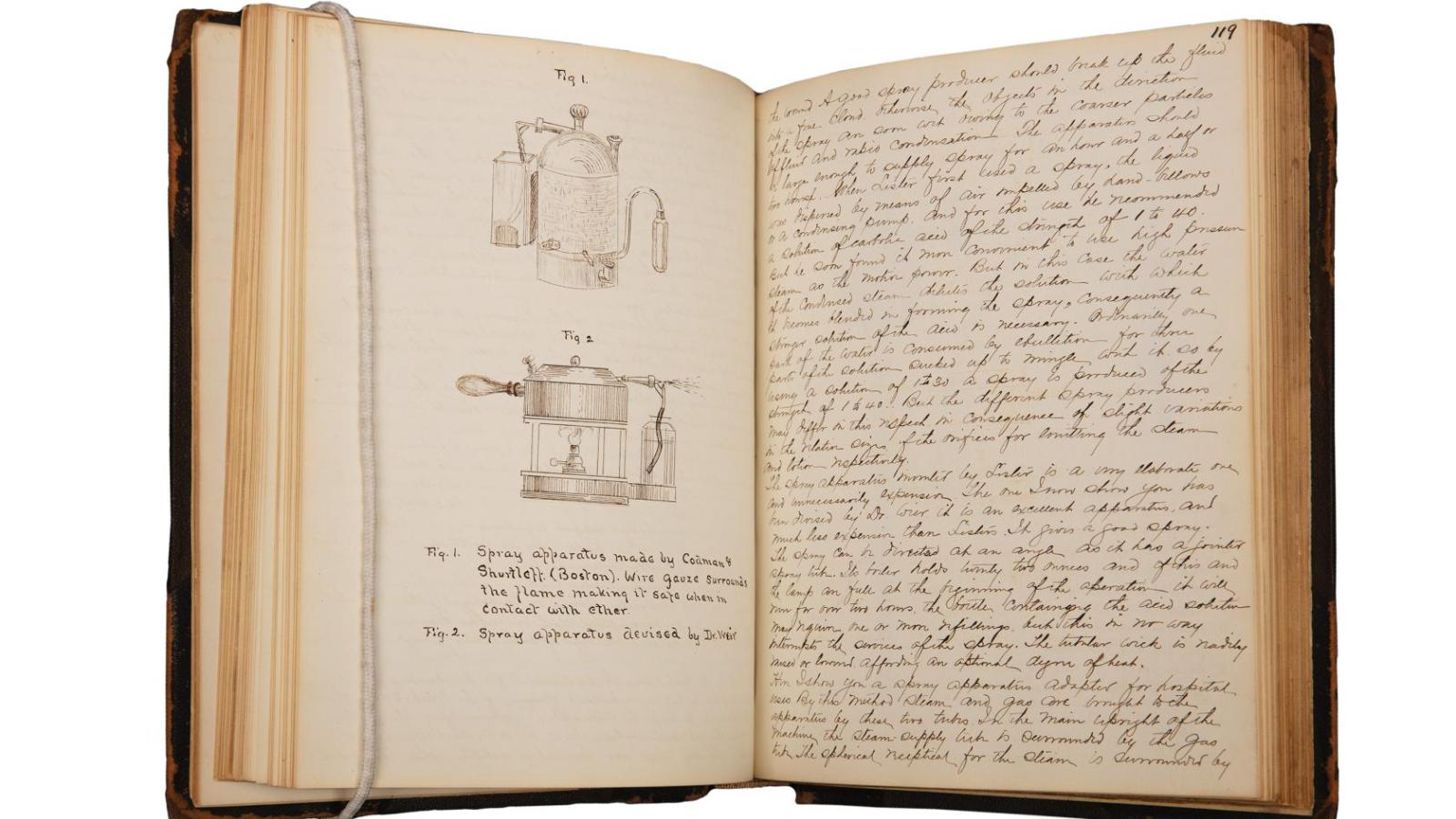
Detailed Depictions
This colored illustration of a cirrhotic liver and black-and-white depiction of an antiseptic “spray apparatus” (in which “wire gauze surrounds the flame making it safe when in contact with ether”) were recorded during clinical lectures delivered and operations performed by the “Medical & Surgical Staff of the New York Hospital” from 1878 to 1879. Staff members mentioned in the notebook include Charles M. Allin, Thomas M. Markoe, James W. McLane, Henry B. Sands, and Robert F. Weir.

Gift of Edwin B. Cragin (P&S’1886), 1917
Germ Theory of Disease
In this 1887 lecture on infectious diseases, Dr. Francis Delafield notes: “It is now believed that most, if not all, of the poisons of infectious diseases are pathogenic micro-organisms. … It is also believed that it is probable that for each separate infectious disease there is a separate & peculiar micro-organism.” This is one of the earliest statements in the notebook collection asserting the germ theory of disease as a fact. Ervin Alden Tucker, P&S’1889, who took these notes in shorthand, later transcribed them for the benefit of “students who do not take any notes at all or only incomplete notes.”

Comparative Anatomy
John G. Curtis (P&S’1870) drew these exquisite anatomical illustrations, probably while a student here. He spent his entire academic life at P&S, where he had a distinguished career as a physiologist. Curtis was a noted book collector, and his library on the history of medicine now forms part of the rare book collection in Archives & Special Collections.

Gift of the family of Dr. Raffaele Lattes, 1999
A New Psychiatric Viewpoint
Arthur Purdy Stout’s medical school psychiatry notes mention the new theories of a Viennese doctor named Freud, including “Hysterical manifestations have an [sic] basis which is brought out by hypnosis. They express symbolically.” Although undated, these notes must have been taken during Stout’s time as a student at P&S from 1908 to 1912.
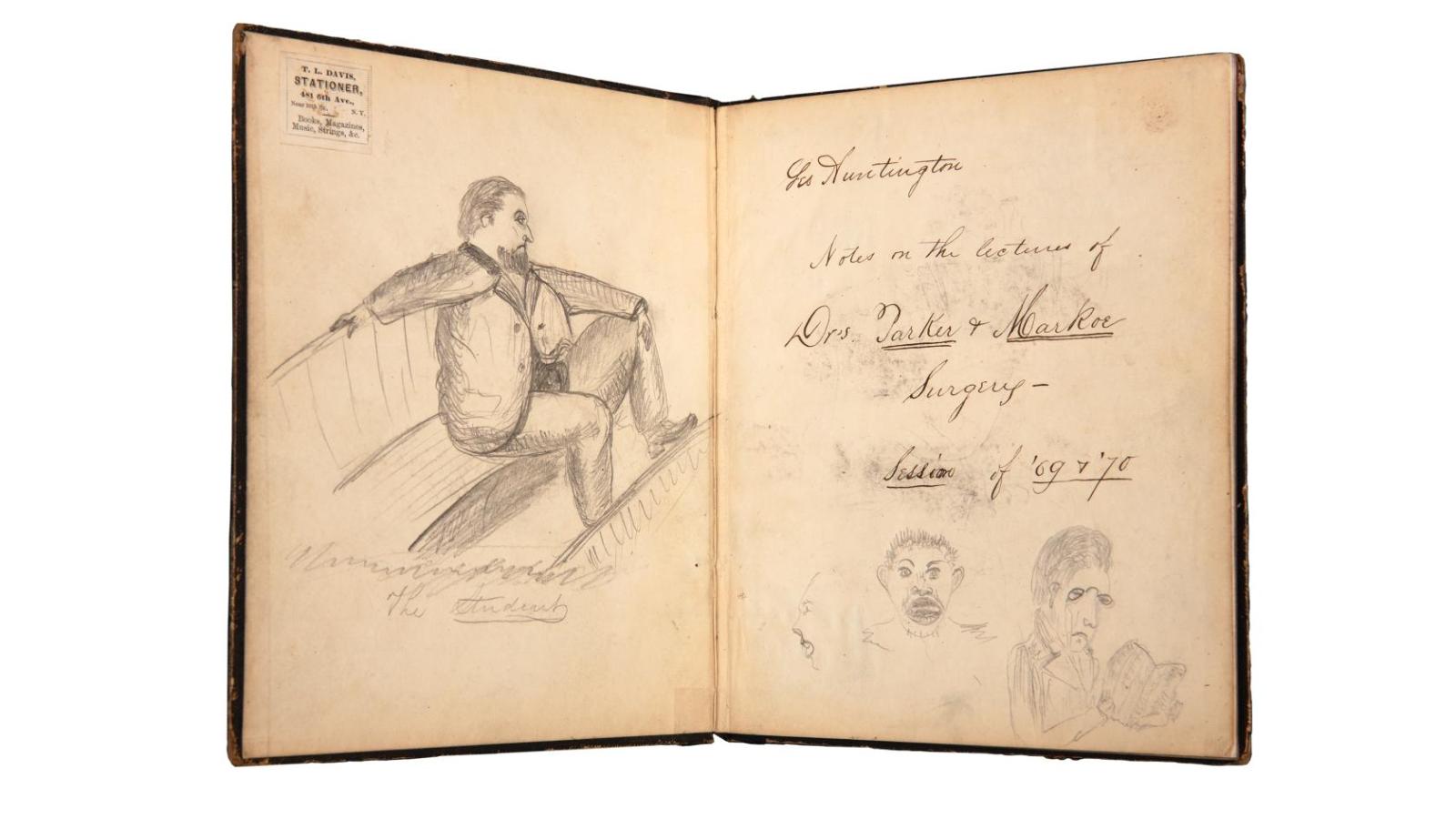
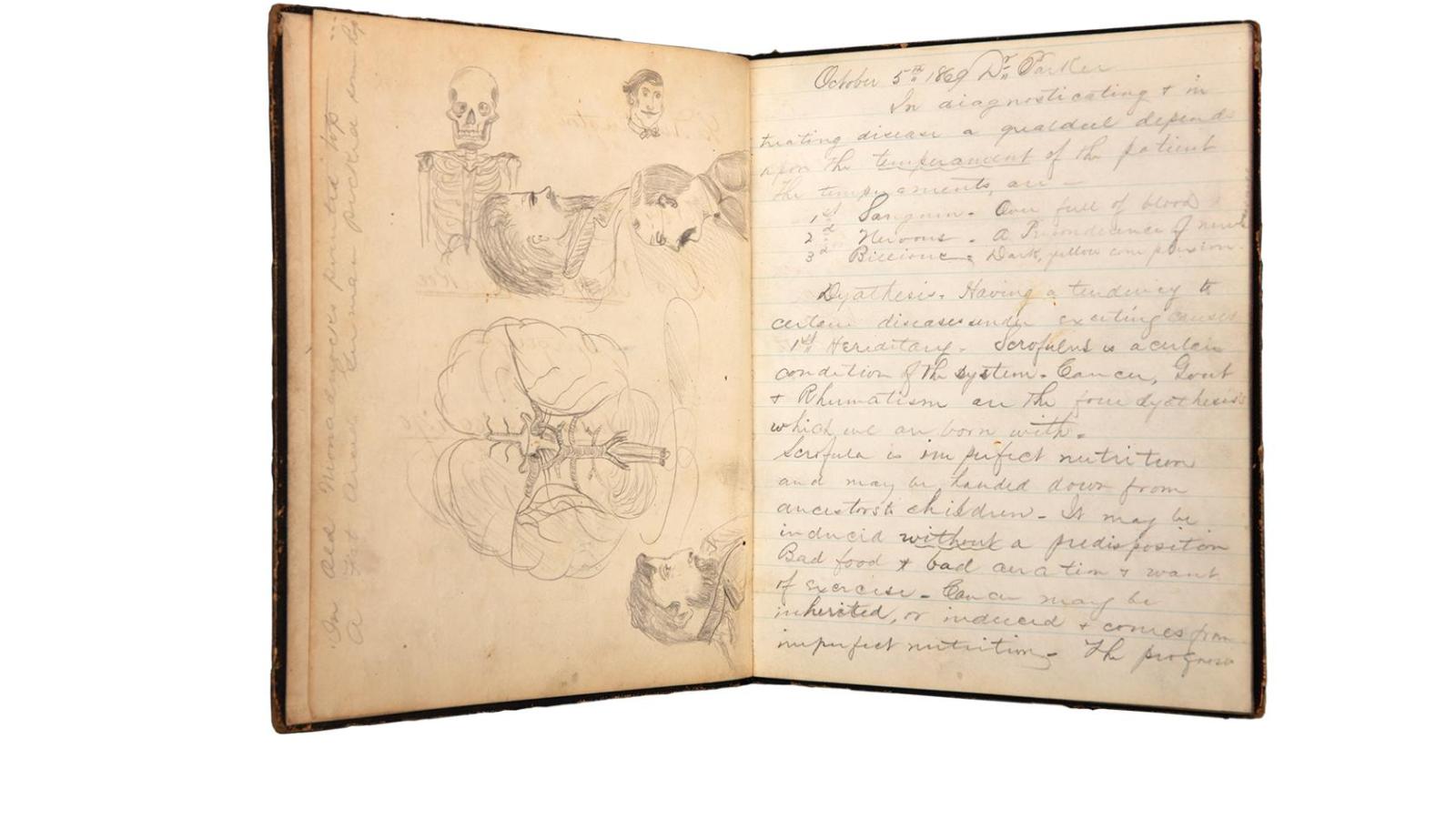
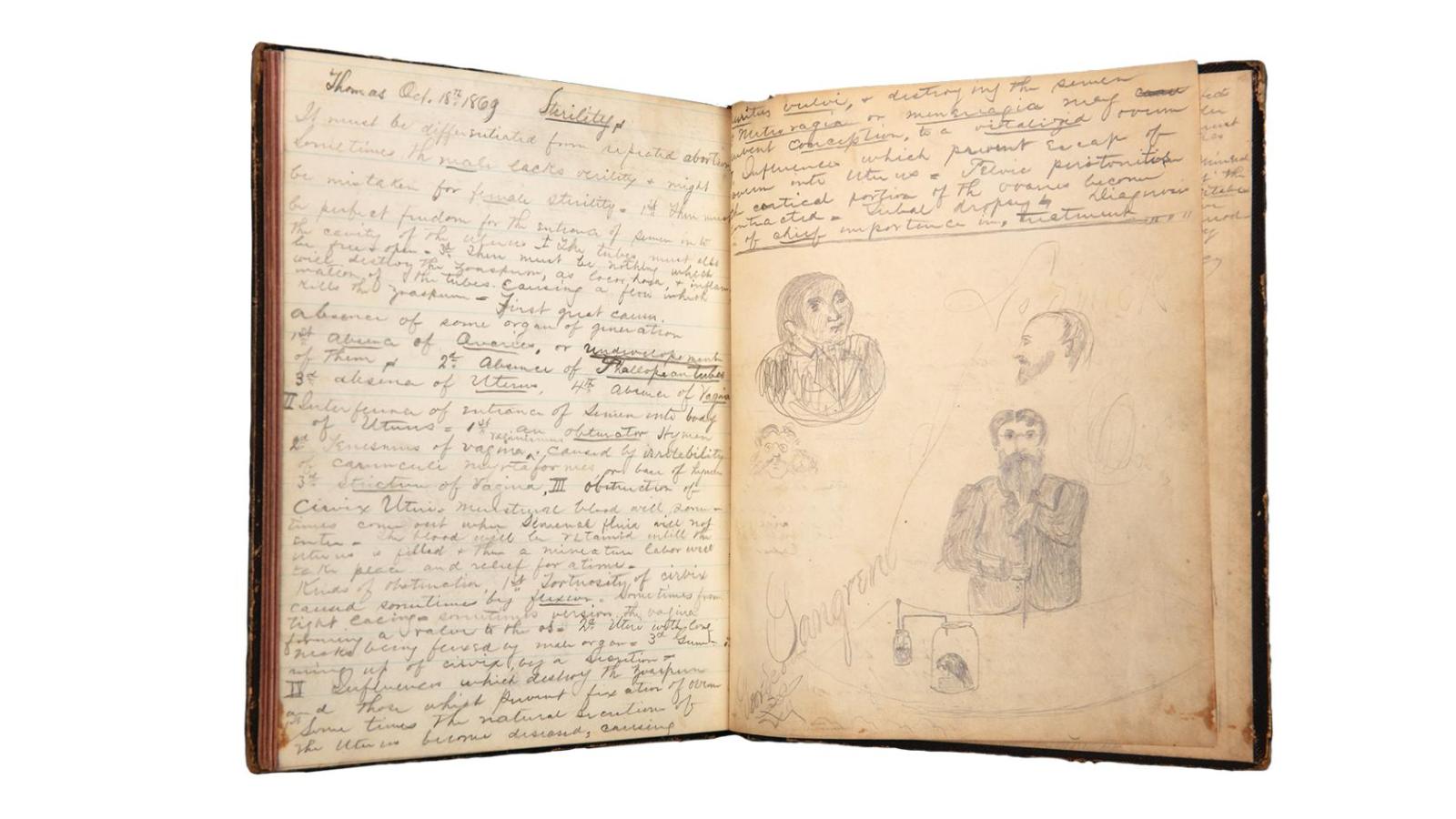
Candid Caricatures
Although George Huntington, the 1871 P&S graduate for whom Huntington’s disease or chorea is named, kept meticulous notes of his medical school classes, he was also a confirmed doodler who adorned his notebooks with caricatures of students and professors, rebuses, and comic sketches. This 1869- 70 volume of surgical notes from lectures by professors Willard Parker and Thomas Markoe shows figures including “The Student” and what appears to be a faculty member.

Friday Afternoon Clinics
This richly colored notebook belonged to student Thomas Rutherford Savage (P&S’1874), son of an early American medical missionary to Africa. He would go on to spend 18 years as physician at the Michigan Hospital for the Insane at Kalamazoo before setting up practice in New York City.
His notes were taken in the “Friday Afternoon Clinics” conducted by Dr. T. Gaillard Thomas, one of the most renowned gynecologists of his time, in the P&S building on 23rd Street. Dr. Thomas had joined the P&S faculty in 1863 and became professor of obstetrics and the diseases of women. He was an innovative surgeon whose “Practical Treatise on the Diseases of Women” went through numerous editions and was translated into 12 languages.